
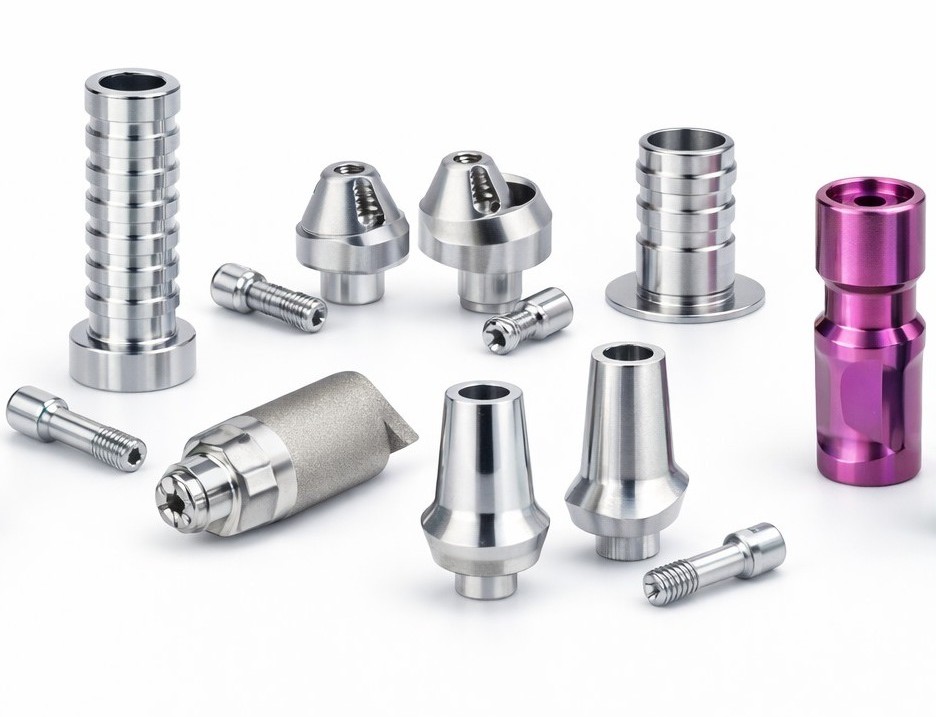
There are three main parameters that mostly determine the difficulty of any machining job:
- Part Complexity
- Part Size
- Material Choice
Any of the three can stop your typical machine shop in its tracks.
Difficult-to-machine geometries and complex part features demand specialized machining systems and setups. For example, you can’t very well tackle intricate profiles, freeform surfaces, or high-precision undercuts with a conventional 3-axis machine.
Likewise, exceptionally small parts and micro-machining demands intricate workholding solutions, potentially necessitating the use of multi-axis Swiss lathe setups with live tooling.
At MedFab, we’ve built our capabilities around solving exactly these types of problems, manufacturing high-precision parts for customers throughout the American aerospace and medical sectors, as well as for industrial and semiconductor clients worldwide.
Two of our most powerful tools we bring to the table that most traditional machine shops lack: our 4- and 5-axis milling centers and our 8-axis Swiss turning lathes.
Here are the capabilities and advantages you can expect for your project, in terms of quality, speed of delivery, and cost per part.
5-Axis Milling: High-Precision and Complexity in a Single Setup
Standard 3-axis machining moves a cutting tool along the X, Y, and Z axes. That covers a lot of ground, but it has a hard limit: the tool can only approach the workpiece from a fixed direction. Any feature that sits on an angled wall, wraps around a contour, or hides beneath an overhang requires repositioning the part, resetting the fixture, and re-establishing your datum. Every time you do that, you introduce potential for error.
4- and 5-axis milling services add rotational movement to the equation. A 4-axis setup introduces rotation around one additional axis, which is already a significant improvement for features like helical slots or contoured profiles. A 5-axis machine tilts and rotates the cutting tool or the workpiece simultaneously, allowing the tool to approach from virtually any angle in a single setup.
That translates into our ability to machine undercuts, freeform surfaces, and complex profiles without ever pulling the part from the fixture. You can probably imagine what that means for a component with multiple compound angles, a turbine-style blade profile, or a medical implant with organic contours. Instead of four or five separate operations with four or five opportunities for cumulative error, we complete those features in one continuous run.
The accuracy improvements are real and measurable. Eliminating repositioning steps removes fixture-to-fixture variation, keeps your datum consistent throughout the operation, and tightens tolerances on finished parts.
We often work with R&D engineers prototyping a new design or moving a component toward production who find such consistency invaluable. It means the tenth or twentieth part matches the first one, and the dimensional data you collect from early runs is actually predictive of what you’ll get at volume. It’s all part of our hands-on, data-driven quality management system – ISO 13485:2016-certified.
5-axis also opens up toolpath optimization. With the ability to tilt the cutter relative to the surface, our programmers can use shorter, more rigid tool lengths to reach deep features. Shorter tools deflect less, vibrate less, and cut cleaner. For tight-tolerance applications, that detail matters more than most people realize.
The Advantages of 8-Axis Swiss Turning for Small Parts and Micro-Machining
Swiss turning has been a precision machining staple for decades, originally developed to manufacture the tiny, tight-tolerance components that the watchmaking industry demanded.
The defining feature of Swiss-style lathes is the guide bushing: the workpiece is supported very close to the cutting zone. That support dramatically reduces deflection on long, slender parts, offering better precision and consistency for micro-machining jobs. The result is exceptional accuracy on diameters and features that would flex and chatter on a conventional lathe.
Our 8-axis Swiss lathes take that foundation and expand it substantially. Traditional Swiss lathes are already capable machines, but additional axes mean additional simultaneous operations. With 8 axes in play, the machine can turn, drill, mill, thread, and cross-drill a part in a single chucking, with multiple tools cutting at the same time.
For small, complex components, this is a genuine manufacturing advantage:
- Consider a part that requires a turned OD, an axial bore, cross-drilled features, a milled flat, and an external thread.
- On conventional equipment, that part moves through multiple machines and multiple operators.
- On our Swiss lathes, it comes off the machine complete or near-complete in one cycle.
The benefits compound quickly. Fewer operations mean fewer handling steps, fewer fixture setups, and less lead time. Parts that might take days to route through a shop can be finished in hours. For engineers in development mode who are iterating quickly, or for buyers managing tight production schedules, that cycle time reduction is a real competitive advantage.
Swiss turning also shines in materials that are difficult to hold tight tolerances on through conventional methods. Stainless steel, titanium, Inconel, and engineering plastics all respond well to the controlled cutting environment a Swiss lathe provides.
Seamless Multi-Axis Machining Integration at MedFab
At MedFab, our 4- and 5-axis milling centers and 8-axis Swiss lathes are part of an integrated approach to precision manufacturing that is designed to handle the parts other shops send back. High-precision medical components and aerospace parts, complex industrial equipment…these difficult-to-machine applications are our beard and butter.
If your next component involves compound geometry, undercuts, small-diameter complexity, or tight tolerances across multiple features, we’d welcome the conversation.