
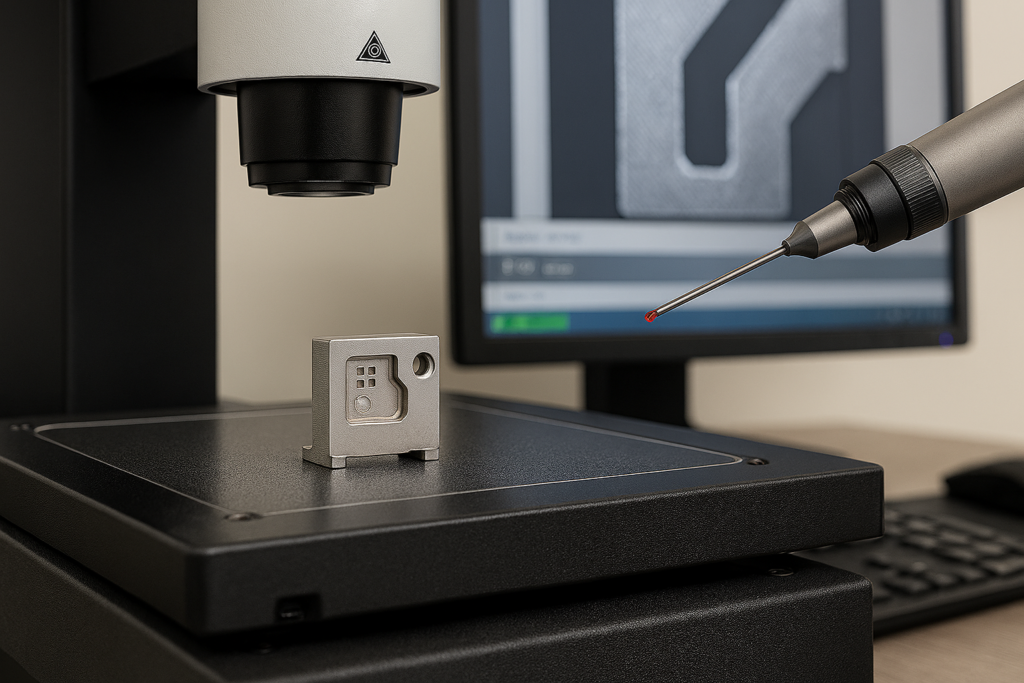
Micro‑machined components—especially those destined for Class II and III medical devices—demand a level of precision that leaves no room for assumption. When features measure in microns and tolerances tighten to the limits of physics, quality assurance becomes more than a checkpoint. It becomes a discipline.
At MedFab Precision Solutions, micro‑machining quality is built on a foundation of ISO 13485:2016‑certified processes, advanced metrology technologies, and a culture of continuous improvement. Our approach ensures that every micro‑feature is measured, verified, and repeatable across production lots—no matter how complex the geometry or material.
Why Micro‑Machined Features Require Specialized Metrology
Micro‑machining introduces challenges that traditional inspection methods cannot reliably address:
- Features may be smaller than a human hair.
- Surface finishes influence device performance and biocompatibility.
- Tool wear can shift dimensions by microns long before visual cues appear.
- Complex geometries require multi‑axis measurement strategies.
To meet these challenges, MedFab deploys a suite of vision systems, coordinate measuring machines (CMMs), and specialized gaging solutions designed specifically for micro‑scale verification.
Vision Systems: Non‑Contact Precision for Micro‑Features
Non‑contact inspection is essential when physical probes risk damaging delicate features. MedFab uses advanced optical systems—including RAM Optical Vision Systems, OGP Sprint MVP Vision Systems, and the Keyence Image Dimension Measurement System—to capture micron‑level detail with exceptional repeatability.
How Vision Systems Support Micro‑Machining QA
- High‑magnification imaging reveals burrs, edge conditions, and micro‑chamfers.
- Automated pattern recognition accelerates inspection of high‑volume parts.
- Non‑contact measurement eliminates probe‑induced deformation.
- Instant dimensional feedback supports in‑process adjustments.
For components with intricate contours or ultra‑small pockets, vision systems provide the clarity and speed required to maintain tight statistical control.
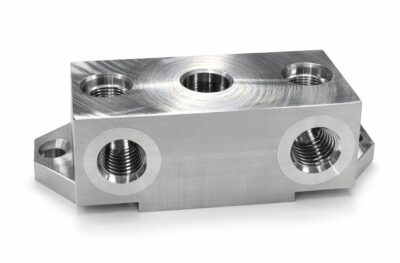
Coordinate Measuring Machines (CMMs): 3D Verification for Complex Geometry
While vision systems excel at 2D and surface‑level inspection, micro‑machined medical components often require 3D validation. MedFab employs manual and programmable CMMs—including Brown & Sharpe systems—to measure form, position, and true geometric relationships.
CMM Advantages in Micro‑Machining
- Sub‑micron probing accuracy for critical datums.
- Multi‑axis measurement for complex 3D features.
- Repeatable automated routines for production‑scale consistency.
- Integration with SPC to monitor process drift over time.
CMMs are especially valuable for verifying features such as micro‑bores, alignment of multi‑step geometries, and positional tolerances that influence device assembly.
Specialized Gages: Fast, Repeatable, Application‑Specific Verification
Not every feature requires a full CMM program. For high‑volume micro‑machined components, MedFab uses custom and precision hand‑held gaging solutions, including profilometers, surface plates, and application‑specific fixtures.
Where Specialized Gages Excel
- Go/no‑go checks for rapid pass/fail decisions.
- Surface finish verification using profilometry.
- Operator‑friendly repeatability for in‑process checks.
- Cost‑effective monitoring of stable, mature processes.
These tools support MedFab’s lean, high‑throughput workflows while maintaining the accuracy required for regulated industries.
Ensuring Repeatability: Statistical Methods and Quality Frameworks
Precision machining is only as reliable as the system that governs it. MedFab’s quality assurance program incorporates industry‑standard methodologies to ensure every measurement—and every part—is consistent.
Capability Studies (Cp/Cpk)
MedFab uses statistical capability analysis to confirm that machining processes remain stable and capable of producing parts within specification.
Gage R&R
Before any measurement system is trusted, MedFab validates its repeatability and reproducibility to ensure the instrument—not the operator—is delivering consistent results.
First Article Inspections (FAI)
Performed to AS9102 standards, FAIs verify that the first part off the machine meets every dimensional and material requirement.
PPAP (Control Plans & FMEA)
For customers requiring deeper validation, MedFab conducts Production Part Approval Process (PPAP) and Failure Mode and Effects Analysis (FMEA) to proactively identify risks and ensure long‑term reliability.
Precision You Can Measure
Micro‑machining demands more than advanced equipment—it requires a metrology strategy capable of validating every micron. Through its combination of vision systems, CMM technology, specialized gaging, and a certified, statistically driven quality system, MedFab ensures that every component meets the exacting standards of the medical device industry.
Whether you’re a startup racing to deliver breakthrough innovation, or a seasoned OEM seeking reliability, traceability, and repeatable precision, MedFab delivers quality you can measure.